
As a polyglot-in-progress, I was thrilled by my first live Bahasa Indonesia class. But there was a small hiccup – the word for library had me completely confused. Perpustakaan? That didn’t sound anything like the words I knew for library in other languages… and this wasn’t the first time that happened!
What does a society reveal about itself in the word it chooses for a building full of books? The answer, I have come to think, is almost everything… its intellectual genealogy, its colonial history, its theory of what knowledge is and who it belongs to. A library is never just a place. It is an argument.
Ludwig Wittgenstein wrote that the limits of my language are the limits of my world. I want to push that claim further: the shape of my language reveals the shape of my world. Nowhere is this clearer than in the word we use for “library” — a term so ordinary that we rarely pause to ask what it assumes.
The Greek inheritance
I grew up with the Dutch word bibliotheek, and my father added the Russian библиотека (biblioteka). These words are transparent in their logic: they derive from Ancient Greek βιβλιοθήκη (bibliothēkē), a compound of βιβλίον (biblion, book) and θήκη (thēkē, case or receptacle). A library, in this tradition, is literally a book-chest: a container, a storage technology.
When the word passed into Latin as bibliotheca and from there into French bibliothèque, German Bibliothek, and dozens of other European languages, it carried this logic with it: knowledge as something that can be collected, housed, enclosed. Already there is a politics lurking in the etymology. A thēkē is something you lock. Something you keep.
The archive is not a neutral vessel. It is, as Derrida reminds us, a domiciliation, a place that names those who have the right to interpret.
Jacques Derrida’s Archive Fever (1995) is a meditation on exactly this structure. The archive, he argues, does not simply preserve what was always already there. It constitutes what counts as preservable — and therefore what counts as history, as knowledge, as worthy of a building. The Greek archē, root of archive, means both “beginning” and “commandment.” To archive is to command: this matters, this does not. The bibliothēkē-tradition encodes that commandment in marble and stone.
The English detour: why “library” looks so different
As a child, the English word library baffled me. Where had the biblio- gone? Why did English, of all languages, abandon the Greek inheritance that seemed so universal?
The answer is that English did not break from classical tradition, but it chose a different classical source. Library stems from the Latin librarium, a place for libri (books). The Roman liber originally meant the inner bark of a tree, the surface on which one wrote before papyrus and parchment arrived. English, ever the linguistic opportunist, borrowed from Latin where the Romance languages borrowed from Greek. Same intellectual tradition, different door.
But this double inheritance has consequences. Derrida was fascinated by the way language retains traces of what it has suppressed. The English speaker who enters a library carries, unconsciously, the ghost of bark and reed — a pre-literate technology of inscription. Words do not simply mean; they haunt.
East Asia: the logic of compound concepts
When I began learning Japanese, the word for library arrived as としょかん (toshokan), written 図書館. I could not connect it to anything I knew, until I encountered its Chinese source: 图书馆 (túshūguǎn). The characters decompose beautifully: 图书 (túshū) means “books” (literally “illustrated writings”), and 館 (guǎn) is a building or hall. A library is a hall of books — a public architecture of thought.
Korean follows the same Classical Chinese inheritance: 도서관 (doseogwan) uses identical conceptual roots: 도서 (books) and 관 (building). Three languages, three phonological systems, one shared cultural architecture, radiating outward from the literary prestige of Classical Chinese across the Sinosphere.
Here Foucault becomes relevant. In The Order of Things, he describes how different epistemes (different historical regimes of knowledge) produce incompatible ways of classifying the world. The Sinosphere’s logographic compound word for library is not merely a different label for the same thing. It encodes a different epistemology: knowledge as visible, layered, compositional. Where Greek locks knowledge in a chest, Classical Chinese builds it into a hall: public, legible, architecturally transparent.
One might object that this is merely a linguistic accident. But Foucault would probably say that there are no accidents in the order of discourse. Every naming is also a placing, and every placing is an act of power.
Perpustakaan: the most beautiful word I did not expect
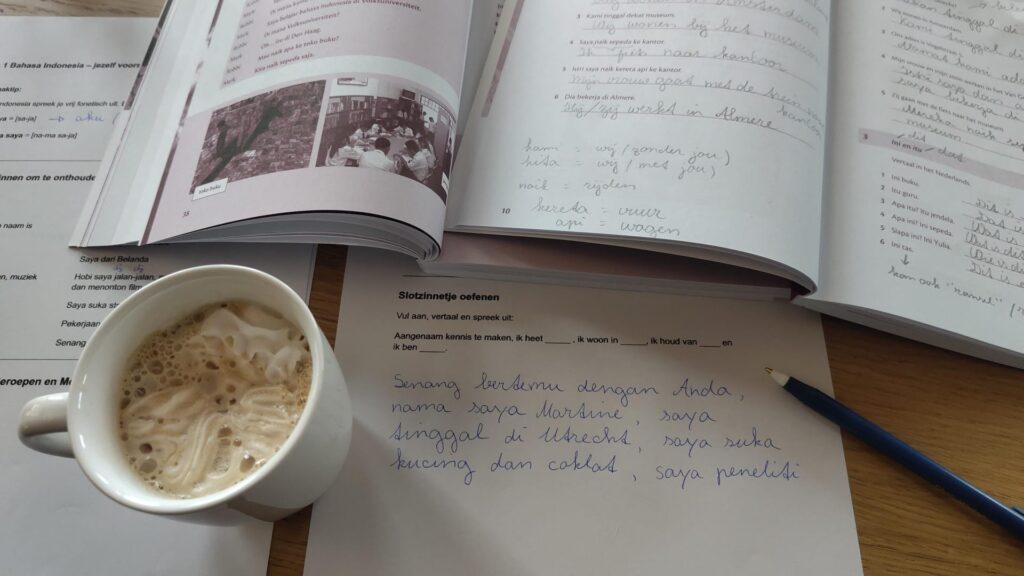
Last Sunday, at my first live Bahasa Indonesia class at the CEAL, I encountered a word that stopped me entirely: perpustakaan. My first instinct was confusion; I had just learned that buku means book in Indonesian. Why did the word for library look nothing like it?
The answer is a small etymological miracle. The base word, pustaka, does not come from Malay or Javanese vernacular. It is Sanskrit, borrowed through centuries of Hindu-Buddhist intellectual culture in the archipelago, when Sanskritic learning was the prestige language of spiritual and political authority across maritime Southeast Asia. Pustaka meant manuscript, sacred text, the kind of writing you did not casually handle. The Bahasa Indonesia word for library is not built on the everyday word for book. It is built on the word for scripture.
A library, in Indonesian, is not a storehouse of books. It is a place consecrated to manuscripts, the kind of texts that demands reverence. The affixes do the rest. Indonesian morphology is magnificently modular: per- and -an together form a nominalising frame that creates “a place of” or “a domain of.” Per- + pustaka + -an = a place of sacred texts. Perpustakaan.
This is where Derrida’s thinking about the archive becomes almost unbearably precise. The Indonesian word for library encodes, still, the memory of a pre-colonial intellectual order in which writing was not democratic or universal but sacred and restricted: produced by priests, kept by courts, interpreted by those with authority. The archive fever Derrida describes (the compulsion to preserve, to house, to institutionalise) here takes on a specifically postcolonial weight. Dutch colonial rule dismantled much of that Sanskritic intellectual infrastructure. The modern Indonesian public library inherits the name of what was lost.
What no concept of “library” is neutral
Return now to Wittgenstein. He was not merely making a point about vocabulary. He was making a point about what it is possible to think. The limits of language are the limits of the thinkable, and therefore of the politically imaginable.
If your word for library comes from a Greek word for storage, you may instinctively think of knowledge as something that can be contained, catalogued, controlled. If your word comes from a Sanskrit word for sacred manuscript, you may carry, residually, an intuition that certain texts demand a different kind of relation — not possession but reverence. If your word builds the concept from visible, composable characters that mean “hall” and “illustrated writing,” you may think of knowledge as inherently public and legible.
These are not the same concept wearing different clothes. They are genuinely different architectures of the mind.
The next time you walk into a bibliotheek, a library, a 図書館, a 도서관, or a perpustakaan, notice what you are entering. Not just a building full of books, but a sedimented argument about what knowledge is, who it belongs to, and what it asks of you. The word above the door was never innocent. It was always already a theory.