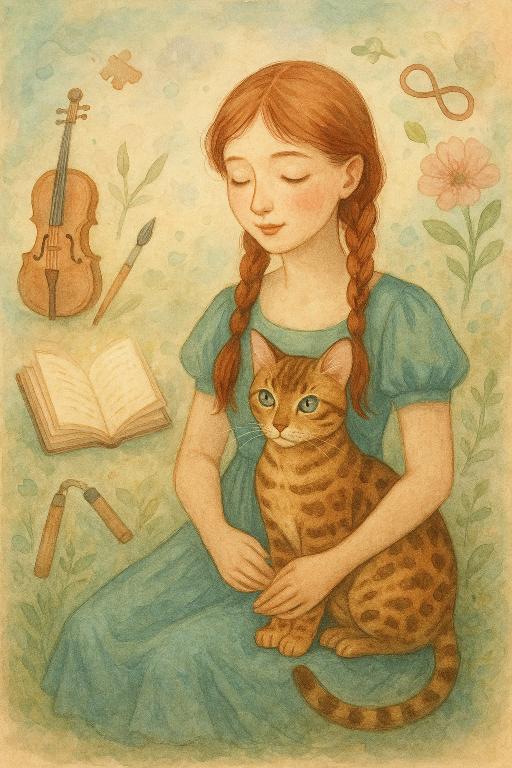
A blog post about the transformative shifts occurring in academic and creative fields, where interdisciplinary cross-pollination is increasingly valued over narrow specialisation. This piece explores how visible and accessible research communication is replacing traditional academic gatekeeping, while authentic, vulnerable narratives are becoming powerful tools for connection. The growing importance of inclusive, participatory formats reflects a broader cultural shift, alongside the rising recognition of lived experience and self-representation as legitimate forms of knowledge. Through personal reflection, the author charts their journey from attempting to conform to embracing the very qualities once deemed “too much.”
For years, I tried to shrink myself to fit into spaces that were never made for me. I was told I was too intense, too fast, too dreamy, too much of everything all at once. In academia, I was expected to pick a lane. In music, I was told to conform to genre and instrument. In martial arts, I had to prove my discipline despite sensory overwhelm. I spent a long time trying to become legible to others. To make sense. To belong.
But something beautiful is happening now, not just within me—but in the world around me. Slowly, spaces are emerging that welcome complexity. The edges are becoming centres. What used to be “too much” is now “just what we needed.” And I want to share with you some of the shifts I’m seeing—some of the qualities that are not only accepted now, but increasingly desirable.
Emerging Desires in the World of Academia, Art, and Neurodivergent Expression
In recent years, a quiet revolution has been unfolding at the intersections of academia, art, and the lived experience of neurodivergence. What was once marginal or misunderstood is now becoming increasingly sought after: not only in theory but in funding calls, exhibition curation, and university hiring practices. The question is no longer whether the world is ready for hybridity, but rather how to make space for it with care and intention.
One of the most notable shifts is the growing appetite for transdisciplinary work. The days of neatly demarcated disciplines are fading; what now captures attention are projects that move between musicology and media theory, between martial arts pedagogy and self-defence philosophy, between poetic expression and empirical data. It is no longer enough to be excellent in one field—there is mounting curiosity about how different fields might speak to one another in new and unexpected ways.
This is accompanied by a hunger for visibility. Researchers are increasingly encouraged to communicate their work beyond academic journals, through podcasts, PechaKucha talks, or Instagram reels. Knowledge, once cloistered behind paywalls, is beginning to walk the streets in more casual shoes—and those who can translate, who can make the complex accessible without losing nuance, are becoming central figures in this new landscape.
At the same time, the role of the artist-scholar has undergone a re-evaluation. Artistic research is no longer seen as an eccentric detour from ‘real’ academia but as a legitimate form of knowing in its own right. The idea that music, illustration, or movement might produce insight—might constitute research—has gained considerable ground, particularly within institutions committed to equity and innovation.
And nowhere is this more urgently felt than in the rise of neurodivergent voices. What was once pathologised is now being re-read as potential: for creativity, for alternative logics, for new forms of knowledge production. Lived experience is no longer a footnote or a source of bias to be bracketed off; it is a methodology. A mode. A perspective that others—funders, curators, peers—are beginning to actively seek out.
These shifts aren’t merely academic—they are deeply political. They mark a change in what is considered valuable, who is considered credible, and what futures we are collectively willing to imagine. For those of us who live at the crossroads of multiple disciplines, who work from a body-mind that has often been excluded or underestimated, this moment is as exhilarating as it is complex. The challenge now is not to become what the industry desires, but to shape those desires from within.
And So I Step Forward, As I Am
I no longer try to edit myself to fit in. I create the work I long to see. I write as a musician, move as a researcher, draw as a martial artist, and teach as someone who once felt voiceless. And people are listening.
If you, too, have been told you are “too much” or “not enough”—perhaps you are exactly what the future is hungry for. Let’s not wait to be chosen. Let’s make the world ready for us.