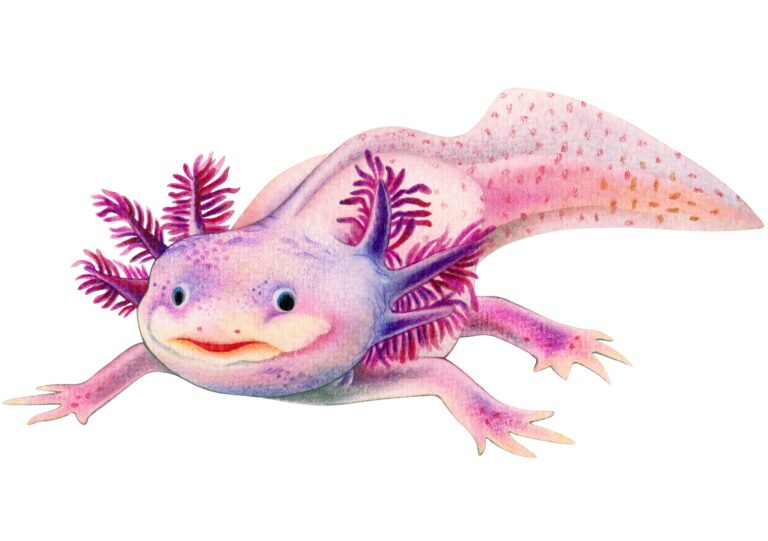
In the crowded aisles of Comic Con, somewhere between the swords and the spellbooks, I began to notice them. A small, pink face peeking out from a tote bag. A plushie tucked under an arm. A sticker, passed from one friend to another like a secret. “Look,” someone would say, “I found another one!”. The axolotl.
Later that evening, my phone lit up with messages. Animated gifs. Tiny waving creatures with frilled heads like underwater crowns. Someone had drawn one. Someone else had found a shirt. We sent them back and forth, not really explaining why. We did not need to.
For most of us, this is how the axolotl appears. Not in water, but on screens. Not as an animal, but as an image. Soft, simplified, endlessly repeatable. We encounter it as something that circulates easily, something that can be shared, collected, recognised almost instantly.
Long before we know anything about this animal, we already knew how to feel about it. There is something about the axolotl that feels immediately familiar, as though it belongs not only to biology, but to a shared emotional vocabulary. Or perhaps more precisely: it comes to move within such a vocabulary. Its wide-set eyes, its soft, almost unfinished body, the delicate branching of its external gills—everything about it seems to invite care. To ask, gently, to be held in attention.
Biologists would call this neoteny: the retention of juvenile features into adulthood. The axolotl, Ambystoma mexicanum, does not undergo the transformation that would carry it into a more recognisably “adult” form. It remains, in a sense, suspended in a larval state. This neoteny is entangled with perception. What we are responding to here has been described before by Konrad Lorenz as the Kindchenschema: a constellation of features (large eyes, rounded forms, softness, vulnerability) that reliably elicit care. These are not neutral traits. They are part of an evolutionary and perceptual loop, in which bodies and responses have shaped one another over time.
The axolotl does not simply have these features. It arrives in a world in which such features already mean something and, crucially, it arrives in a world where those meanings circulate. Because the axolotl most of us know is not the animal. It is the version that moves. The one that appears in drawings, gifs, plushies, stickers—small, simplified, slightly exaggerated. Each repetition smooths it further. Each iteration makes it easier to recognise, easier to share, easier to love.
In this process, something subtle happens: the axolotl becomes less a creature, and more a carrier of feeling. This is where something like Actor-Network Theory becomes useful, as a way of noticing that the axolotl is not one stable thing. It is enacted differently across networks. As organism, as image, as object of exchange. Notably, these versions do not circulate equally: the image travels, the animal does not.
Most people will encounter hundreds, perhaps thousands, of axolotls in their lifetime without ever seeing one alive. The balance is not even. It is overwhelmingly tilted toward the mediated, the softened, the endlessly repeatable form, the version that teaches us how to feel. When does another version appear?
A quick search reveals something less accommodating. The axolotl requires cold water, typically between 16 and 18 degrees Celsius. It is highly sensitive to changes in water quality. Light, touch, and strong currents can cause stress. Its care is precise, demanding, and often unforgiving. The “axo” in its circulated form, as softness and simplicity, becomes something else entirely. Not an object of effortless affection, but a life structured by narrow conditions.
The axolotl’s life does not adapt to the ease with which we have learned to hold it. And even there, we do not encounter a pure, untouched animal. As Donna Haraway reminds us, these encounters are always mediated—through aquariums, care practices, infrastructures, forms of knowledge. The “real” axolotl is not outside of these systems.
And yet, despite this mediation, something resists within the limits of our projection. The axolotl does not become easier because we have seen it a hundred times as an image. It does not simplify itself in response to our familiarity. It does not meet us in the emotional vocabulary we have built around it.
This is where the tension sharpens, between illusion and reality, but even more between a form that invites effortless feeling, and a life that demands something else entirely. When a creature moves from meme to material, then, it is not simply that we correct a misunderstanding. It is that the relationship itself becomes more serious. Affection no longer circulates freely. It has to attach, persist and take form in practice.
Axolotls ask something of us that goes beyond admiration and that raises a more difficult question than it might first appear. Can our love survive the shift in form? The circulated version is light, available and confirming, whereas an encounter with the living animal does not return that movement. Now, it becomes tempting for me to write that the axolotl does not recognise us and does not reflect our feelings. But that would still be to measure it against our own expectations. Perhaps the point is not that and animal like this fails to return our love, but that it exists entirely outside of that exchange.
This is where the encounter begins to change, in a way that recalls Emmanuel Levinas. An encounter with something that does not confirm us and places a demand upon us might be a disruption. For the axolotl did not ask to be adored. It does not ask to circulate and/or to become a sign of something we feel. It simply exists.