A short article originally written in Dutch for the Stichting van Hamel voor Keltische Studies.
My research actually began in a rather embarrassingly ordinary way: I saw a handsome man on Netflix — King Alfred (David Dawson) in The Last Kingdom — and I was immediately captivated. Not only by his appearance, but especially by the enigmatic character of his world. What kind of script was that on the manuscript shown on screen (hmm… it looks like Asser, but with a little Bayeux-tapestry boat)? What board game were they actually playing (hmm… some form of Hnefatafl with the Lewis chessmen)? And the choreography is entertaining, but what did sword fighting in that context really look like (hmm… did the Vikings actually use testudos in the classical sense)?
It became one great puzzle full of riddles — which, surprisingly, all led to the historical figure of Alfred the Great. His story, and especially the countless ways in which it is retold today in fan fiction, touched upon everything that had long fascinated me: stories, translation, rituals, martial arts, psychology, faith, and the tension between principles and pragmatism.
In Alfred I recognised something deeper. Not only his moral dilemmas, but also his vulnerability moved me. According to tradition, Alfred suffered from a chronic condition, possibly Crohn’s disease and/or epilepsy. Just as I, with my autism, constantly have to navigate between my own needs and the expectations of the outside world, he was forced to structure his life around circumstances over which he had no direct control. In fan fiction about him, that struggle is often amplified. It is precisely in those scenes that I recognised something of my own experience: how strength and vulnerability can coexist — and even reinforce one another.
What began as curious fascination gradually developed into a serious scholarly pursuit. I have published dozens of articles on the topic and spoken at various conferences. Secretly, I dream of writing a scholarly book about it. Through fan fiction I even rediscovered an old love: Celtic languages and cultures, which I studied years ago as part of a minor. To my surprise, Celtic elements appear remarkably often in modern Alfredian fan fiction.
Magical figures such as druids and banshees are frequently introduced as advisers or adversaries of Alfred or his allies. References to Celtic myths and figures from the Arthurian tradition also appear, suggesting a blending of historical and mythic Celtic traditions. In addition, we encounter symbolism such as triskele tattoos, rituals surrounding the solstices, or the use of Celtic languages in spells or prayers. These elements lend the stories a distinctly “Celtic aura” that may be historically anachronistic but proves narratively meaningful. That, in turn, became another fascinating puzzle — and that puzzle forms the starting point of this article.
This personal journey led me to an intriguing scholarly question. Fan fiction — originally derived from the English term “fan fiction”, which emerged in the 1960s within science-fiction communities — refers to fictional stories written by fans that are based on existing characters, worlds, or storylines from other media. Unlike professional adaptations, such as Tolkien’s The Lord of the Rings (in which the author created his own mythological world), fan fiction writers explicitly build upon existing narratives. They adopt characters and settings from popular media — such as television series, films, books, or historical sources — and reinterpret them in new ways.
Celtic elements in Alfredian fan fiction
The prominent use of Celtic elements in Alfredian fan fiction is historically paradoxical. By the time Alfred became king in the late ninth century, Celtic culture had largely disappeared from the regions that formed his kingdom. Historical sources indicate that after the Roman conquest of Britain (43–84 CE) and the subsequent Anglo-Saxon migrations from the fifth century onwards, Celtic populations were gradually pushed to the margins of the British Isles. Wales, Scotland, and Ireland became the final strongholds of Celtic culture, language, and traditions, while the area that would later become Alfred’s Wessex had largely been “Anglo-Saxonised”.
Despite this historical reality, modern fan fiction about King Alfred frequently contains references to Celtic mythology, rituals, symbols, and characters. These stories create a fascinating tension between historical authenticity and creative freedom. Authors integrate elements such as ogham inscriptions, references to Celtic gods such as Lugh and heroes such as Cú Chulainn, and neo-pagan rituals into their narratives about the Christian Anglo-Saxon king.
This choice reflects a broader cultural tendency in which “the Celtic” functions as a symbol of mysticism, spirituality, and closeness to nature — qualities that resonate strongly with contemporary aesthetic and literary preferences.
This article examines how and why fan fiction authors incorporate Celtic elements into stories about Alfred the Great, and what this reveals about the role of fan fiction as a platform for cultural memory and historical reinterpretation. By analysing this digital literature, we gain insight into how historical figures are interpreted in the twenty-first century, and how modern authors navigate between respect for historical sources and the freedom of creative imagination.
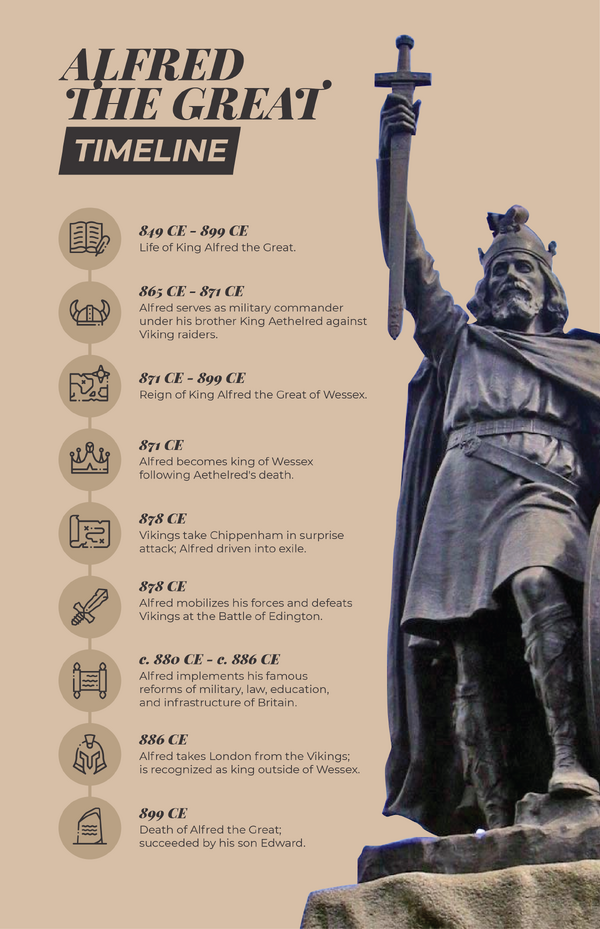
Alfred the Great (849–899)
King Alfred is often portrayed as a heroic ruler who not only defended his people against relentless Viking attacks, but also laid the foundations for education and culture within his kingdom. One of the most valuable primary sources about Alfred is the Vita Ælfredi regis Angul Saxonum (893), written by Asser, a Welsh monk who served as the king’s teacher and confidant. This work forms an important part of the narrative tradition surrounding Alfred that continues to this day.
Asser’s biography is particularly valuable because he personally knew Alfred and witnessed many of the events he describes, although modern historians such as Simon Keynes and Michael Lapidge note that the text also contains hagiographical elements that idealise the king.
Alfred’s military successes against the Vikings — most notably his victory at the Battle of Edington in 878 and the subsequent Treaty of Wedmore — are well documented in the Anglo-Saxon Chronicle. This primary source, whose compilation Alfred himself encouraged, demonstrates that he was not only a war leader but also a strategic thinker. His system of burhs (fortified towns) and the reorganisation of the army (fyrd) laid the military and administrative foundations for the later English kingdom.
Yet Alfred was more than a warrior king. Both primary and secondary sources emphasise his role as a cultural reformer. He promoted the translation of Latin works into Old English and encouraged the compilation of the Anglo-Saxon Chronicle. His translation projects included important works such as Gregory the Great’s Pastoral Care, Boethius’ Consolation of Philosophy, and Augustine’s Soliloquies.
Alfred also founded schools and promoted the use of the vernacular in literature and scholarship, believing that knowledge should be accessible to all. He made his translations more understandable for his audience by employing Anglo-Saxon literary techniques and adapting the texts to the worldview of his readers. Interestingly, these translations were collaborative projects: Alfred worked with scholars from Wales, Mercia, and the Continent — much like modern online fan fiction, which is often written collectively by multiple authors.
By making texts available in the vernacular, Alfred aimed to stimulate learning and intellectual development among his largely illiterate subjects. His efforts contributed to the development of Anglo-Saxon culture, identity, and literacy, and laid the groundwork for what Patrick Wormald has called the “Alfredian Renaissance”.
Alfredism and cultural memory
During the eighteenth and nineteenth centuries, Britain witnessed a veritable cult surrounding Alfred the Great. His figure was celebrated in literature, visual art, political speeches, and public commemorations. This admiration — often referred to as “Alfredism” — reflected the spirit of the age.
Figures such as the poet James Thomson praised Alfred in his poem Liberty (1735–1736), portraying him as the founder of English liberty. The historian David Hume described him in his influential History of England as the ideal monarch who combined learning and military prowess. Later, during the Napoleonic wars, the politician and historian Sharon Turner used his History of the Anglo-Saxons to present Alfred as an early symbol of English resistance against continental tyranny.
These authors used Alfred as a prism through which to interpret the upheavals of their own turbulent centuries, thereby cementing his enduring reputation as a national hero.
The influence of Alfredism extended well into the twentieth century. During the First World War, Alfred was once again invoked as a symbol of British determination, and the thousandth anniversary of his death in 1901 attracted thousands of visitors to Winchester. This long tradition of Alfred-veneration created a rich cultural context in which modern adaptations — from BBC documentaries to Netflix series — could flourish.
Fan fiction around Alfred the Great
At the beginning of the twenty-first century, fan fiction writers have added a new layer to the narrative tradition surrounding Alfred the Great. Whereas earlier portrayals were often based on historical chronicles or academic biographies, this new generation of stories is largely inspired by popular media productions: television series, historical novels, and films.
These popular sources create an Alfred who is less strictly historical and more aligned with contemporary storytelling conventions concerning heroism, conflict, and identity. As a result, an alternative narrative tradition emerges in which Celtic elements, magical-religious motifs, and romantic archetypes play a prominent role.
In such stories Alfred often appears as a figure balancing human vulnerability with a near-mythical role as protector of the land, reminiscent of the archetypal “warrior king” from Celtic legend.