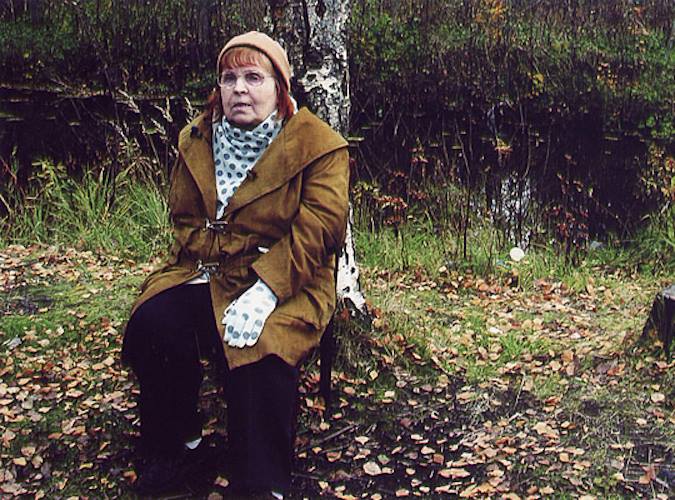
A follow-up of my blog post on why we continue to programme Russian music – and how, below are some thoughts on programming women composers. Rooted in my work as music librarian for the Domcantorij (the choir & orchestra of the Dom church in Utrecht), in which I assist our cantor with programming.
The Composer Who Said No
When Galina Ustvolskaya was invited to a festival of women composers, she declined. Her written response has the quality of all her music: sparse, unsparing, unwilling to accommodate. Could a genuine distinction between music written by men and music written by women be made? She thought not. “We should only play music that is genuine and strong,” she wrote. “An interpretation in a concert of women composers is a humiliation for music.”
I have been sitting with this sentence. Remco — our cantor, with whom I share our library & programming — and I have argued about it, inconclusively and productively, in the way that the best arguments go. I asked two colleagues whose thinking I admire: Rachel, a soprano who is also a historian, and Mirella, a soprano who is a theologian. Their responses sharpened the question without resolving it, which is the most one can reasonably ask.
We have placed Ustvolskaya’s Fourth Symphony on our International Women’s Day programme anyway. This essay is an attempt to explain why — and to be honest about what that decision costs.
The Paradox of the Category
Ustvolskaya’s objection is not merely aesthetic. It is, at its core, a philosophical claim about identity: that to name a category is to create a boundary, and that boundaries are always also exclusions. A festival of women composers implies that women composers are something other than composers. The supplement — women — does not add; it qualifies, it diminishes, it marks a departure from the unmarked norm.
There is a long tradition of thinking here. Simone de Beauvoir observed that Woman is always defined in relation to Man: not an autonomous subject but a deviation from the default. The category “woman composer” operates within this same grammar. It concedes, structurally, what it tries to resist: that composing is a male thing, and women who do it require special designation.
Ustvolskaya understood this intuitively. She had spent her career refusing the Soviet state’s demand for categories — Soviet composer, Russian composer, ideologically reliable composer — and she extended that refusal here. The integrity is real. The logic is defensible.
And yet…
What the Logic Ignores
Rachel’s response is the one I keep returning to. The aesthetic argument (play only what is genuine and strong) is valid in the abstract. But it presupposes a level playing field that has never existed. The canon of Western classical music is not a neutral record of what was strongest. It is a historical artefact, shaped by who had access to education, to instruments, to publishing houses, to the ears of conductors. “Anonymous,” in music history as in literary history, most likely conceals more women than most people realise.
And there is something else that Rachel noticed that I could not unknow once she had pointed it out: “genuine and strong.” These are almost exactly the terms that were used, for centuries, to define the capacity for composition as a specifically male capacity. The argument that women did not share what was once called the divine power of artistic creation rested precisely on their supposed inability to produce work that was genuine and strong. Ustvolskaya, in trying to escape the prison of gendered categorisation, reached instinctively for the vocabulary of the jailers.
This is not a character flaw. It is what Bourdieu would call a disposition formed within a field, the habitus of a person who survived the Soviet musical establishment by internalising its terms of value. One does not simply think one’s way free of the structures that formed one’s thought.
The Deeper Problem: Corrective Measures and Their Costs
And yet, here I want to resist the too-easy conclusion, as I think that the critique of Ustvolskaya does not straightforwardly vindicate concerts like ours.
Mirella raised this from a theological angle: is there a risk that by marking International Women’s Day as the occasion for this programming, we implicitly say that women composers belong to a special occasion rather than to all occasions? That their music is extraordinary (literally meaning outside the ordinary) rather than simply part of what music is?
This is not a trivial worry. There is a genuine debate, unresolved, between two strategies for addressing structural exclusion: the strategy of separate space and the strategy of integration. The first creates visibility but risks reinscribing Otherness. The second avoids that risk but may, in practice, leave exclusion untouched. Both positions carry costs. Neither is simply right.
What I have come to think (and I hold this as a hypothesis rather than a conclusion) is that the choice between them is not primarily philosophical but historical. Not: which approach is correct in principle? But: which conditions obtain in practice, and what do those conditions demand?
Those historical conditions can be read at three levels, which are related but not identical. Numerical parity (the percentage of women composers in a programme) is the easiest measure and the least meaningful. If fifty per cent of programmed composers are women but all their works are assessed against a canon that still functions as a neutral standard, then the corrective has populated the structure without changing it. Canonical parity asks something deeper: are women composers not merely programmed but canonised, aka incorporated into the reference frameworks through which musicians, critics, and audiences understand what “the repertoire” is? So long as Ustvolskaya functions as a curiosity and Shostakovich as a benchmark, the corrective remains incomplete. And institutional parity (who leads conservatoires, who writes in the major music journals, who sits on programming committees, who receives commissions for new works etc etc) determines whether the parity achieved is structurally embedded or dependent on individual goodwill.
The transition from corrective to integrated programming is justified only when all three dimensions no longer need to sustain themselves through deliberate intervention. That is a high threshold. We are not there.
Why Ustvolskaya, Specifically
Which returns us to the paradox: we are programming a composer who would have objected to being programmed in this context. Why?
Ustvolskaya’s biography is more complex than a clean separation between public and private would suggest. She held teaching positions at the Leningrad Conservatoire. She was Shostakovich’s student — a relationship that opened doors unavailable to others, and which left traces audible to anyone who looks for them: in the rhythmic energy of the early works, in certain harmonic habits, in the handling of extreme dynamics. Her reputation within the USSR was partly institutionally facilitated. She did not stand outside the structures; she knew them from within.
This does not diminish her integrity. But it nuances her. She was not the unsullied outsider but the survivor who eventually refused to go on serving and that refusal carries a different, perhaps more interesting, moral weight than the refusal of someone who had never had anything to lose.
Her famous claim that there is “no link whatsoever between my music and that of any other composer, living or dead” is legible in this light as a statement about intention and destination, not about origin. She does not deny that she came from somewhere. She refuses to acknowledge that her music points anywhere. It is authorship as future, not as past. That the claim has something pugnacious about it, something that raises an eyebrow in anyone who knows the early works, makes it more human, not less serious. You need not have lived through what she lived through to understand why someone might decide that distance is the only protection still available.
The music itself makes the argument more forcefully than biography can. The Fourth Symphony is scored for just four performers (trumpet, tam-tam, piano, and mezzo) and lasts between six and eight minutes. It sets the words of Hermannus Contractus, an eleventh-century Benedictine monk. There is nothing decorative in it. It does not accommodate. It demands everything from the listener and offers nothing by way of consolation. If the implicit charge against programming women composers separately is that it implies their music belongs to a softer, more occasional register, this is music that refuses the charge before it is made.
The Russian Question, Again
Earlier this year, I wrote about why we continue to programme Russian music. About the Kremlin’s use of Tchaikovsky above the ruins of the Mariupol theatre, about the impossible position of performing cultural heritage that has been weaponised. Ustvolskaya is Russian. She is also, arguably, the composer whose work most systematically refused the terms of the Russian cultural state. The Soviet musical establishment demanded accessibility, ideological legibility, mass appeal. Ustvolskaya wrote, in secret, works she believed might never be heard.
Programming her on International Women’s Day means holding several things simultaneously: solidarity with Ukraine, refusal to cede Russian culture to the Kremlin’s narrative, commitment to corrective programming, and honest engagement with a composer who would have quarrelled with the framing. These do not resolve into each other. They remain in tension. I think that is the correct response to the situation. Not resolution, but sustained, attentive tension.
The Company She Keeps
There is one more thing worth saying, and it is perhaps the most concrete argument of all. Ustvolskaya does not appear on our programme alone. She appears alongside Hildegard von Bingen, whose music predates the Western canon by several centuries and helped constitute it; Chiara Margarita Cozzolani, a Milanese abbess whose sacred concertos were published and performed in the seventeenth century and then largely forgotten for three hundred years; Lili Boulanger, the first woman to win the Prix de Rome, who died at twenty-four and left behind work of startling maturity; Elsa Barraine, her near-contemporary, a pupil of Paul Dukas and a member of the French Resistance; and Caroline Shaw, an American composer working today, the youngest recipient of the Pulitzer Prize for Music.
Six composers. Six centuries. Three religious contexts, of a kind: Benedictine, Counter-Reformation Catholic, and the secular-sacred territory that Shaw navigates in works like Partita for 8 Voices. What connects them is not gender but seriousness: each made work that was, in Ustvolskaya’s own terms, genuine and strong. That they were systematically under-heard is not an aesthetic judgement. It is a historical fact. Therefore, for us, placing them together is not an act of segregation, but an act of introduction.
What We Are Doing and Why
I do not believe that music transcends politics. “Art transcends politics” is a comfortable fiction, usually invoked to avoid discomfort. Music is made by people, in conditions, for audiences who bring their histories into the concert hall with them.
But I also do not believe that music is reducible to politics. Ustvolskaya’s Fourth Symphony (those six to eight minutes of trumpet, tam-tam, piano, and a single voice) is not a political programme. It is a particular kind of attention to existence. The question is not whether to bring politics to bear on it but how to do so without flattening what makes it irreducible.
We programme this concert because the structural conditions of exclusion have not ended. We programme Ustvolskaya because her music is among the strongest arguments that the exclusion was a loss. Not for women primarily, but for music. We hold her objection to our framing alongside our decision to frame it this way, without pretending the tension disappears.
We remain, as always, open to being wrong.