On the website of the Royal Society for the History of Dutch Music, I had the pleasure of offering readers a glimpse behind the scenes of the Domcantorij.
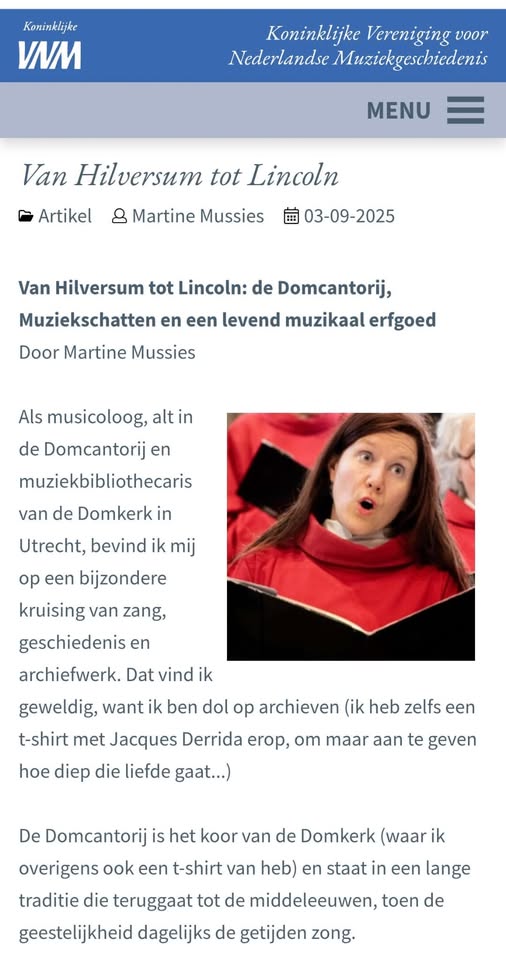
As a musicologist, an alto in the Domcantorij, and music librarian of the Dom Church in Utrecht, I find myself at a rather special crossroads of singing, history, and archival work. I absolutely love that position, as I have a deep affection for archives (I even own a T-shirt featuring Jacques Derrida, which says quite a lot about the extent of that passion…).
The Domcantorij is the choir of the Dom Church (of which I also, incidentally, own a T-shirt) and stands within a long tradition reaching back to the Middle Ages, when the clergy sang the daily offices. With the advent of the Reformation, much changed, yet music has never ceased to resound within the Dom Church. The Domcantorij, in its present form, has existed since 1971. We sing during services, vespers, and concerts, and, every two years, during a choir tour to England, where we spend a week singing Evensong and Sunday morning services in a cathedral setting.
Behind the scenes, my role as music librarian is essential to all of this. Together with our Domcantor, Remco de Graas, I ensure that we choose, locate, organise, edit, and preserve the right repertoire. Our archive has quite literally outgrown its seams: from the sacristy to the attic, and even the former organ bellows chamber, sheet music is housed in spaces that require constant care and attention. The collection continues to grow daily. We are fortunate that many composers have written music especially for us—from a new descant for an English hymn by Erik Heijerman to an entire opera, Martine & Martinus, by Carlijn Metselaar. Occasionally, I myself contribute unexpected discoveries, bringing chants from England or songs from Germany back into our fold.
During a choir tour to Lincoln Cathedral, we performed, among other works, a beautiful composition by Siegfried Reda (1916–1968): Ecce Homo. We had also programmed this piece in April, alongside the equally remarkable Markus Passion by Johannes Driessler (1921–1998). However… Ecce Homo had, quite simply, vanished. Nowhere was it to be found. The ever-helpful team at Broekmans & Van Poppel arranged a reprint via Bärenreiter, but that would take some time—and rehearsals could not wait.
Fortunately, there is Muziekschatten (Musical Treasures) the broadcasting archive of sheet music. At the invitation of Eric van Balkum and Jan Jaap Kassies (two key figures in preserving and unlocking this musical treasure trove), our cantor Remco and I travelled to Hilversum. There, over excellent coffee, fascinating stories, and a truly dizzying tour, we were able to obtain study copies to begin our rehearsals. Thanks to the archive of Muziekschatten, we could already bring the piece to life, and, in doing so, take it with us to Lincoln Cathedral!
For me, as both a musicologist and a librarian, Muziekschatten is an inexhaustible source of inspiration. It provides access to forgotten repertoire and unique heritage that might otherwise be lost. This aligns beautifully with the mission of the Domcantorij: to keep early music alive within a contemporary liturgical practice. A well-shaped liturgy carries the power of recognition. As my friend Jenny—who sings soprano in the choir—once put it so beautifully: the fixed elements of a service are like buoys at sea; they show you where you come from and where you are going.
Within our choir, we share both joys and sorrows, and together we contribute to music that offers comfort, strength, and beauty. That, to me, is of inestimable value, and I hope to continue doing so for many years to come.