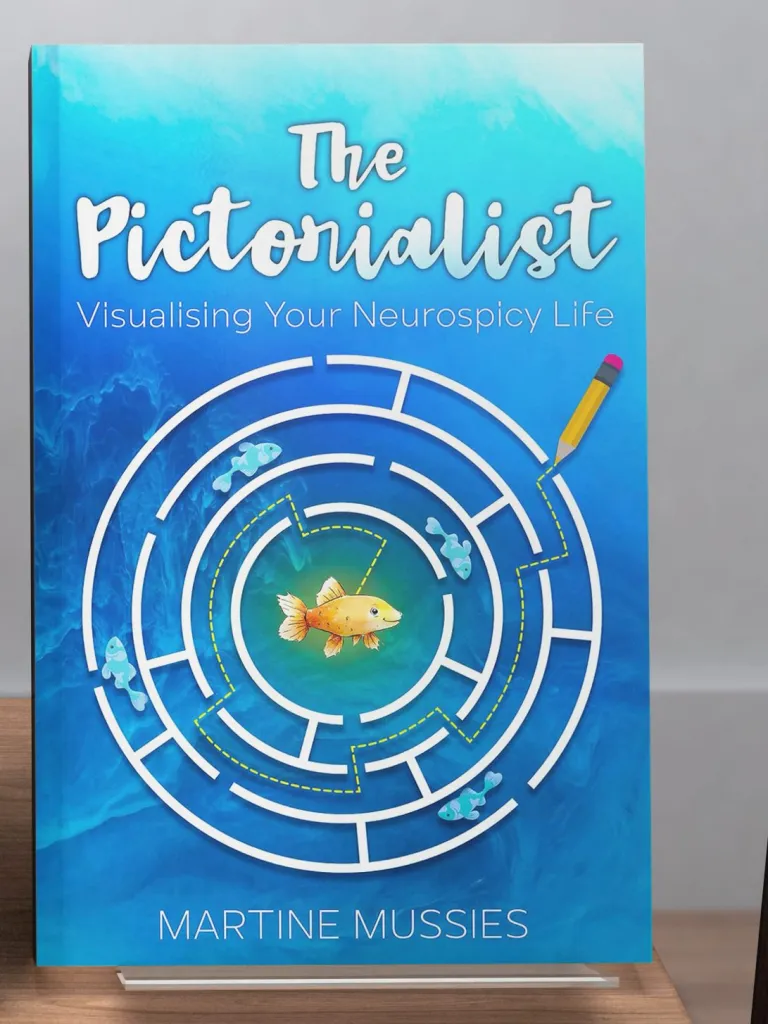
Sam from Tistje.com — a large Dutch website about autism — has read my book The Pictorialist and written this wonderful review. I’m so grateful (and honestly a bit moved) to see how deeply they engaged with it. Thank you so much!
The Pictorialist by Martine Mussies: An Illustrated Journey Through the Autistic World
“If so much of what I thought was me turns out to be learned behaviour, what remains that is truly mine?”
This is a question many autistic people ask themselves sooner or later — often after a diagnosis or during burnout. Martine Mussies, herself autistic and a researcher, not only asks this question but seeks answers. Not with one single conclusion, but through a set of tools for self-understanding.
The Pictorialist is not a medical handbook filled with dry facts. It is what Mussies calls an auti-ethnography: personal stories from her life as an autistic person in a world designed mainly for non-autistic people. The book serves as a starting point for reflection and dialogue.
Why so many drawings?
After her first book Inside the Autside (2023), readers told her how much her drawings and diagrams helped them understand themselves — how images can capture complex feelings that words alone cannot.
The title comes from a compliment she once received: “You’re a pictorialist!” — a maker of images. For Mussies, drawing is not a choice but a necessity. “My differently wired brain often made it impossible to grasp complex ideas without visualising them.”
The result is an atlas of an inner world: full of infographics, mind maps and collages. Many illustrations are deliberately unfinished, inviting readers to complete them with their own notes and reflections.
Who am I beneath the mask?
The first part, Mapping the Self, explores identity formation in autism — a process that is “neither easy nor automatic.” Mussies describes her memories as “a stack of disconnected photos rather than a flowing film.” Her sense of self emerges not from a single story but from patterns she recognises among scattered fragments.
Societal pressure and years of masking complicate this further, often leading to what therapists call complex trauma. The book shows the tension between how the world sees you and how you truly feel.
“Special interests” play a central role — not as obsessions or symptoms, but as ways of becoming oneself and creating a meaningful life. Mussies describes many autistic women as multipotentialites: creative minds forming identity through multiple passions.
Beyond a hobby
Mussies reframes “special interests” as a way of being in the world. What is often dismissed as repetitive behaviour becomes, in her hands, a form of deep connection to reality.
Here she sharply critiques the medicalised language of psychology, which still frames autism as a disorder. She exposes how descriptions like “restricted and repetitive interests” reveal more about social power than about autistic experience. It’s a call to recognise alternative ways of thinking.
While the book powerfully advocates neurodiversity — presenting autism as an identity and not just a condition — readers who experience autism primarily as a disability may find less resonance. Still, The Pictorialist invites a rich and necessary dialogue between medical and philosophical perspectives.
A sensory world
In Tuning In, Mussies explores sensory processing and introduces the concept of “sensory permeability” — describing how autistic perception filters (or fails to filter) stimuli. She connects this to the Japanese philosophical term junsui keiken (pure experience): a direct, unmediated encounter with reality.
Even common issues like eating or sleep are reinterpreted — not as defects, but as results of a brain that experiences the world differently. Her idea of transitional architecture — evening rituals to ease into sleep — is both poetic and practical.
Social navigation, differently
In Translating Neurotypes, Mussies redefines social interaction through the concept of Doing Social: favouring functionality over performance, transparency over small talk, and collaboration over competition.
Autistic directness, she argues, is not rudeness but “a radical act of respect for the mental and emotional energy of others.” Her F-P-E model (Future, Physical, Emotional) offers a clear framework for analysing relationships, while her “Circle of Coping” helps manage Rejection Sensitive Dysphoria (RSD).
When someone truly sees you
The most moving concept is Access Intimacy — those rare moments when someone understands you without endless explanation. Mussies illustrates this with two opposing experiences: the grace of being wordlessly supported in a choir rehearsal, and the pain of being falsely accused of lying during an internship — a vivid lesson in epistemic injustice.
These stories capture both the beauty and the heartbreak of being autistic in a world that often misunderstands difference.
Autism in the wild
Later chapters focus on real-life strategies: designing autism-friendly spaces, handling decision fatigue, and parenting reflections. Her metaphors — comparing autistic planning to “an old-fashioned slide projector” rather than “a PowerPoint presentation” — are both charming and precise.
Authenticity as political act
Rich, layered and original, The Pictorialist blends personal narrative with philosophical and scientific thought, from Sartre to Foucault, yet remains accessible and beautifully visual.
It’s not a book to rush through, but to work with — a workbook, mirror, and guide. Mussies positions authenticity as a political act, echoing Audre Lorde: self-care is not indulgence but self-preservation.
Ultimately, this is not just a book about autism, but a book through autism — an invitation to question our assumptions about normality, communication, and connection.
For those willing to accept that invitation, The Pictorialist offers profound insight — not only into autism, but into the fragile and luminous essence of being human.
The Pictorialist by Martine Mussies
Published in 2025 • Independent release
Paperback • ISBN 979-8-297-42618-4
Available on Amazon and other major platforms