And why you might too, once you start opening those dusty drawers…
I’ve just returned from England — a whirlwind trip that combined public speaking, library-haunting, and a few stolen moments of quiet inspiration in the British drizzle. The highlight? Presenting at the conference Actors, Singers and Celebrity Cultures across the Centuries, hosted by the Theatrical Voice Research Centre at the University of Surrey in Guildford.
It was a dream. Academics, performers, artists and archivists all gathered to explore how voices (both literal and metaphorical) echo across history. There was opera gossip from the 1700s, handwritten notes from Victorian stage stars, and even a discussion about AI voice synthesis — all equally fabulous. My own contribution? A reflection on how fan archives can be read as creative acts in themselves — full of gaps, textures, and agency.
But let’s be honest: the real romance started a little earlier. On my way to Guildford, I made a necessary pilgrimage to the British Library, where I got to peer into some of their collection materials — parchment, ink, marginalia. I lost an hour (or three) just staring at some musical notation from around 1000 to around 900, marvelling at how much can be said in silence.
Tomorrow, I’ll be back in my local role as a music librarian at the Domkerk in Utrecht, continuing the slow and delicate work of cataloguing centuries of sacred music. It’s a form of daily devotion, really — part archaeology, part poetry. As a neurodivergent person, I find incredible peace in the clarity of archival structures, the quiet rhythm of sorting, naming, preserving. There is such beauty in the almost invisible. I feel I am listening to history in a language without words.
And yet: archives are never neutral. As Jacques Derrida reminds us in Archive Fever, every archive is an act of power — a decision about what is kept, and what is allowed to fade. I think often about how neurodivergent minds like mine move through time differently, storing memory in non-linear ways. Perhaps that’s why I feel at home among papers no one has touched for years. They wait, without judgement. They hum.
In my ongoing interviews with the team behind Muziekschatten, I’ve been asking archivists what drives them. The answers vary — curiosity, care, devotion — but the one thread is love. Archives are, above all, acts of love. Not nostalgic, but radical. They insist that someone will care about this score, this note, this pencil mark, someday. That’s a deeply human hope.
So yes. I think archives are sexy.
Not in the glossy magazine sense, but in the Björk-sings-in-an-ice-cave sense. Quiet, layered, unexpected. Full of secrets. And if we listen closely enough, they just might teach us how to time travel — not backwards, but deeper.
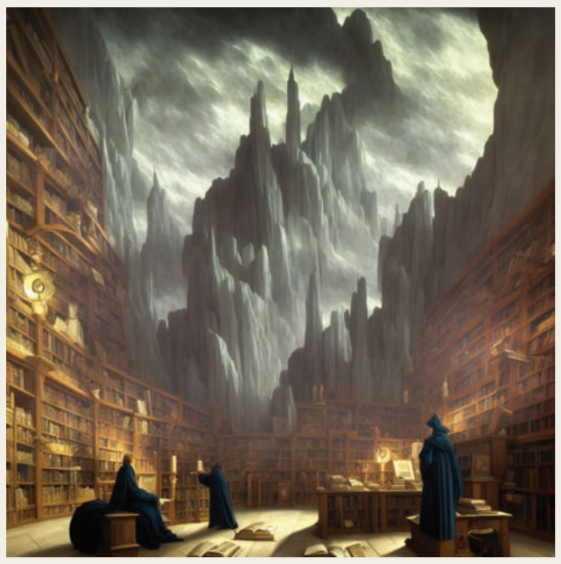
My digital fantasy art Archive Fever was published in Lembas (the magazine of the Dutch Tolkien Society) and exhibited at the Neude Library in Utrecht, the Netherlands. The unique canvas print of it is now in a private collection, but posters are still available via the BudoGirl Etsy.