Somewhere on my desk lies a drawing of a man in two guises: in one, he’s a martial artist, poised in crisp iaidogi, every fold inked with reverence. In the other, he’s a sleepy salaryman in slightly causal businesswear, mid-coffee-slurp. He’s the same man, really, brought to life twice over with careful lines and a stubborn refusal to let an algorithm do the job for me. The style? A love letter to East Asian illustration, with a wink to Korean manhwa and a bow to the narrative elegance of Japanese manga. Entirely hand-drawn, in what I like to think of as analogue devotion.
Why am I telling you this? Because lately, my social feeds have been overrun with “Ghibli-style” images spat out by AI models that have never picked up a brush. And although I also see many positives to AI generated fanart, this did made me wonder: can you steal an art style?
Legally speaking, no. Style — the airy softness of a watercolour sky, the particular swagger of a line stroke — isn’t protected by copyright. You can’t claim exclusive rights to ‘vibes’. But ethically? That’s murkier than a bad ink wash.
We’re living in a time when AI can be coaxed into mimicking almost any artistic tradition with startling precision. With the right prompts, it can cough up a scene that feels just like something from a Miyazaki film, but without the soul, the backache, or the ten-year production schedule. It’s all look, no lineage. As the man himself once said, such work can feel like “an insult to life itself”. And he’s not wrong. When style becomes mere surface — unanchored from its cultural context or the human effort that shaped it — what’s left?
Some jurisdictions — like France and Japan — take moral rights more seriously, recognising an artist’s right to the integrity of their work. Even the UK, with its more relaxed attitude, raises an eyebrow when style imitation veers into the territory of misleading branding or false endorsement. Could an AI-generated artwork be treated like a knock-off handbag? Possibly, if it rides too closely on the aesthetic coattails of a recognisable creator.
But the more interesting question, to me, is not legal. It’s ethical. What does it mean to pay homage — and when does homage curdle into theft? Can you appropriate not the content of someone’s work, but the feeling of it, the cultural breath behind the brushstrokes?
I’d argue that intention matters. Drawing by hand — even clumsily, imperfectly — is a kind of dialogue with the artform itself. It acknowledges the lineage. It takes time. It aches a little. That’s not to say digital tools are inherently bad (I adore Procreate as well as Photoshop), but AI shortcuts that mimic with no understanding are something else entirely. They flatten what should have depth.
So, can you steal an art style? No — not in court. But in the dojo of artistic integrity, it’s a bit more complicated. And perhaps that’s where the real discussion begins.
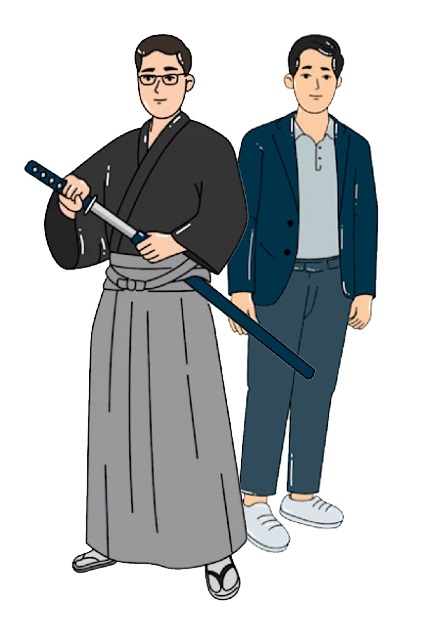
Illustration: BudoGirl’s hand-drawn iaidōka // kaishain, in a semi-Korean style — brush to paper, no AI in sight.
Update! Interested in the legal side of all this? You can now read my academic article “AI, Fanart and Intellectual Property – an Analysis of Ownership in The Age of Machine Creativity” in the International Journal for Crime, Law and AI.