As part of our autism moral circle project, we were recently asked to share someone who inspires us, someone who holds an important place in how we think about the world as autistic individuals. For me, such a person is Temple Grandin.
An Inspiration in My Moral Circle
I explained in our circle how I first encountered Temple as a child, long before I knew I was autistic myself. She appeared in the title narrative of An Anthropologist on Mars (1995) by Oliver Sacks, which I read in Dutch, and I remember being instantly captivated by her. Even at that young age, something in her resonated with me—especially the way she described her deep connection with animals. It felt like someone was putting words to feelings I had always carried but never been able to articulate.
Over the years, Temple Grandin became a guiding figure for me—both personally and professionally. Her dedication to improving the lives of non-human animals and advocating for autistic people has shaped the way I think about my own mission in life. She didn’t separate her identity as an autistic person from her academic work or activism—on the contrary, she used her differences as a strength. That taught me that our neurology isn’t something we have to overcome; it’s something we can channel.
As a researcher, artist and musician, Temple’s influence is woven into the fabric of my artistic research. She inspires me to connect intellect with emotion, and science with empathy. Her ability to ‘see in pictures’ and translate those visualisations into groundbreaking designs reminds me of the value of non-linear, sensory thinking—the kind of thinking that’s so often sidelined in academia, but which has immense power when nurtured.
In my own life, I also feel close to Temple in the way she lives among and with animals. Her kinship with cows and horses mirrors the gentle, mutual understanding I feel with Boris the Bengal Tigercat and the other creatures I share my life with. It’s a relationship built not on words, but on presence, sensation, and care. Temple models for me what it means to treat all living beings—human or otherwise—with dignity, respect, and attentiveness.
There’s also something quietly revolutionary in how she carved out space for herself in worlds that weren’t made with her (in) mind. Academia. Agriculture. Public discourse. She stepped into those spaces with a fierce clarity and made them more humane, not just for herself but for others who would follow. That is something I hope to do too, in my own way—through music, through research, through sharing my story as an autistic woman.
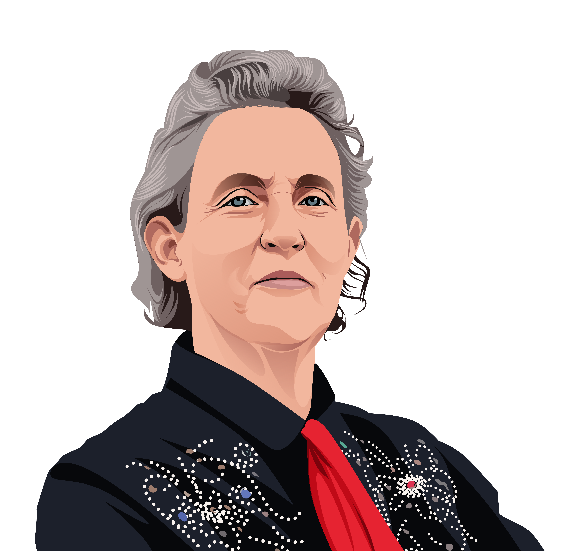
Temple Grandin – the movie
There’s also a film made about her life, simply called Temple Grandin (2010, HBO), which I’d love to write a proper review of sometime in the future. Unlike many portrayals of autism in film, this one offers a more nuanced depiction of adult autism, focusing not on a miraculous ‘cure’ or tragedy, but on Grandin’s intellectual journey and ethical vision. Claire Danes plays Temple with real sensitivity, and the film traces her growth from an isolated, misunderstood teenager to a pioneering scientist and advocate for the ethical treatment of animals.
Although it sometimes slips into the “you’re so inspiring, I mean, for an autist!“-trope (of the ‘autistic savant’ or ‘supercrip’), Temple Grandin ultimately portrays her autism not as a deficit, but as a form of perception that enables unique contributions to science, ethics and design. It also does something rare: it centres the autistic adult woman as protagonist, and presents her world with complexity, clarity, and compassion.
Temple’s story shows us that being “different, not less”—as her mother puts it—is not just a sentiment. It’s a radical truth. A truth I carry with me, every day, in everything I do.