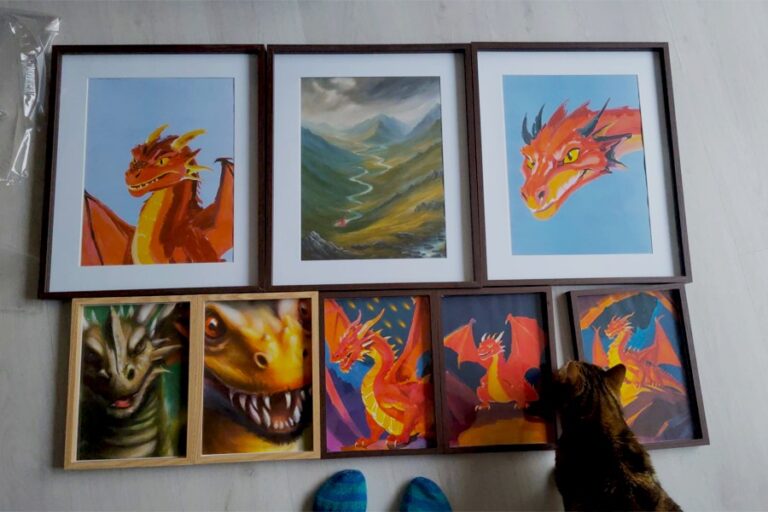
This short article was originally published in Dutch in Lembas, the magazine of the Tolkien society Unquendor, accompanied by one of my own dragon illustrations.
There were lots of dragons in the North in those days, and gold was probably getting scarce up there, with the dwarves flying south or getting killed, and all the general waste and destruction that dragons make going from bad to worse. There was a most specially greedy, strong and wicked worm called Smaug.
Thorin (J.R.R. Tolkien, An Unexpected Party, The Hobbit)
Dragons play a central role in the works of J.R.R. Tolkien and are among the most fascinating and fearsome creatures in Middle-earth. They are far more than fiery beasts; they are intelligent, cunning, and often symbols of greed and destruction. Tolkien drew inspiration for dragons from various mythological sources, including Norse mythology, the Bible, and classical literature such as Beowulf.
Tolkien, a lover of Norse mythology and medieval literature, reflected these influences in his descriptions of dragons. The Old English epic poem Beowulf features a dragon called Gifer, or “the greedy one,” which closely resembles the dragons in Tolkien’s world. In many of these tales, dragons are seen as symbols of corruption and destruction, often tied to deeper moral meanings.
In addition to mythology, the Bible played a key role in Tolkien’s imagination. In Old English biblical texts, the serpent that tempts Eve in the story of the Fall is often referred to as a “wyrm,” a term that can denote a worm, serpent, or dragon. This term, used in medieval texts for reptilian creatures, often symbolised evil, sin, and temptation. Tolkien, deeply familiar with these languages and cultures, used “wyrm” not only to describe physical monsters like Smaug but also to explore the moral corruption and greed they embody. The biblical association of the wyrm with the Fall of Man strengthens this symbolism in his narratives.
While Tolkien’s most iconic dragons reside in Middle-earth, he also created dragons in other settings. A notable example is Chrysophylax Dives, a dragon from the comedic tale Farmer Giles of Ham. Chrysophylax is a whimsical and greedy dragon with a considerable hoard and a clever, albeit overconfident, personality. While his role is not as dark as that of Middle-earth’s dragons, Chrysophylax reflects Tolkien’s fascination with dragon-like creatures and their symbolism. Unlike the purely destructive nature of Smaug or Glaurung, Chrysophylax offers a playful take on dragons, highlighting the versatility of Tolkien’s approach and his ability to bring dragons to life as vivid and fascinating beings outside Middle-earth.
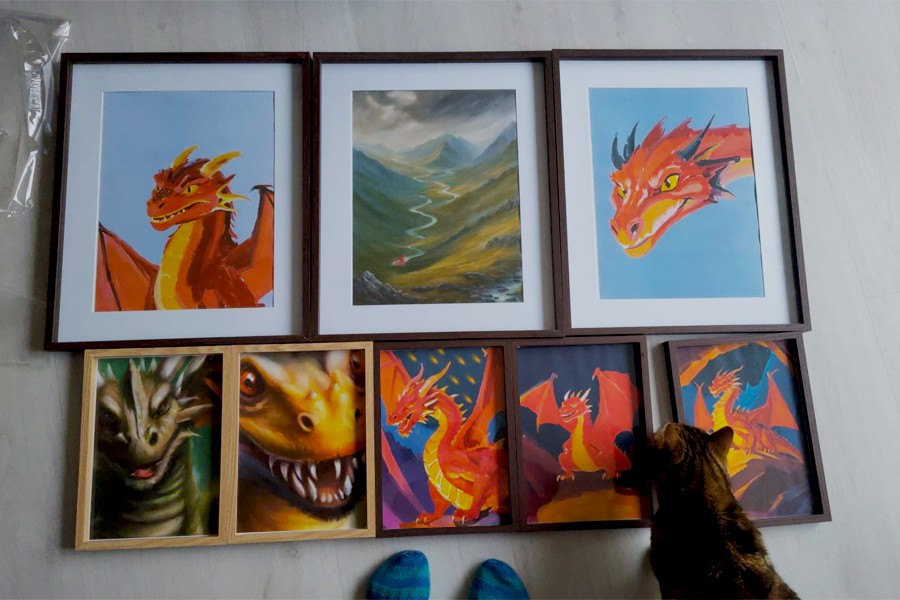
The Four Famous Dragons of Tolkien
- Scatha
Scatha, known as the “Long Worm,” lived in the Ered Mithrin, the Grey Mountains of northern Middle-earth. He was slain by Fram, an ancestor of the Rohirrim. His death led to conflict between the Men of Rohan and the Dwarves over the treasures Scatha left behind. Although less well-known than other dragons, Scatha had a lasting impact on the history of the Rohirrim, evidenced by Éowyn’s possession of a horn from Scatha’s hoard. - Glaurung
Glaurung is one of the most terrifying dragons in Tolkien’s legendarium and is considered the “Father of Dragons.” He plays a pivotal role in the tale of Túrin Turambar, deeply influencing the tragedy of Túrin and his family. Glaurung was wingless, but his immense power and malevolence made him deadly. He destroyed Nargothrond, a mighty Elven kingdom, and used his magic to ensnare Túrin’s sister, Nienor. Glaurung’s impact extended beyond physical destruction, leaving a trail of emotional devastation. - Ancalagon the Black
Ancalagon is unquestionably the largest and most powerful dragon in Tolkien’s stories. Created by Morgoth, he played a decisive role in the War of Wrath. This immense, winged dragon was so massive that his fall shattered the towers of Thangorodrim. Ancalagon, a fire-breathing Urulóki, ranks among the most destructive beings in Middle-earth’s history. His death marked the end of the First Age. - Smaug
Smaug the Golden is arguably the most famous dragon in Tolkien’s works, thanks to his role as the antagonist in The Hobbit. Smaug conquered the Dwarven kingdom of Erebor and claimed its treasures as his own. Known for his exceptional intelligence and pride, Smaug’s greed and arrogance make him an iconic figure in fantasy literature. His death at the hands of Bard the Bowman led to the reclamation of Erebor by Thorin and his company but also sparked new conflicts over the treasures he left behind.
Conclusion
Dragons in Tolkien’s world are far more than simple monsters. They embody deeper themes of corruption, greed, and destruction, inspired by mythology, literature, and religion. They are not just physical threats but also moral challenges that expose the inner weaknesses of characters. Dragons, as reptilian embodiments of evil, represent both the crawling and seductive aspects of temptation. In the Bible, the wyrm is often associated with sin and decay, a theme Tolkien picks up in his stories of corrupted dragons like Smaug. Whether through Túrin’s tragic downfall under Glaurung or the destruction wrought by Smaug, Tolkien’s dragons are as complex as the world they inhabit.