An English translation of Paardjes, porselein en powervrouwen, originally published in Dutch in China Vandaag, the Dutch-language members’ magazine of the Belgium–China Association, November 2025.
During my visit to the exhibition “Wu Zetian – The Only Female Emperor of China” in Leeuwarden (spring 2025), I immediately fell in love with the colourful ceramic horses from the Tang dynasty (618–907 CE). The elegant, lively figures with their tricolour glaze ignited my imagination. Behind these artworks lies a rich story: that of an exceptional woman who rose to supreme power in a world dominated by men. In this article I explore the world of Wu Zetian, the art of her time, and the feminist questions her legacy raises today: what does female power mean, then and now?
The life of Wu Zetian (624–705) reads like the plot of a historical novel. Her journey began as a concubine of Emperor Taizong, and after his death she became a concubine of his son and successor Gaozong. Through intelligence and political acumen she rose to the rank of empress. After Gaozong’s death in 683 she ruled first as empress regent, but in 690 she did something unprecedented: she founded her own dynasty, the Zhou dynasty, a brief intermezzo (690–705) within the long Tang period. Yet in these fifteen years Wu Zetian left an indelible mark on Chinese history, crowning herself emperor—not empress, but emperor. For the traditional Confucian elite, this was an intolerable violation of the natural order. The very idea of a woman sitting upon the Dragon Throne was unthinkable to them.
It is therefore unsurprising that, after her death, male historians painted Wu Zetian as a ruthless, bloodthirsty tyrant who gained power through cruelty and manipulation. Modern historians, however, have sketched a more nuanced picture, informed by feminist and postcolonial theory, urging us to look more critically at how female rulers have been represented. We now see that Wu Zetian was indeed merciless towards her opponents, but no more so than the male rulers of her era. Moreover, she enacted important reforms: lowering taxes for farmers, improving military organisation, and strengthening the merit-based civil service examination system. This gave talented individuals from lower classes, including women, opportunities they would otherwise never have had.
Wu Zetian was particularly skilled in using symbolism to legitimise her authority. She embraced Buddhism, which afforded women a more egalitarian status than Confucianism did, and even had it declared that she was the reincarnation of Maitreya, the Buddha of the future. She commissioned artworks that reinforced her position. During her reign she introduced twelve new Chinese characters—a remarkable act, as the Chinese script is traditionally regarded as sacred, stable, and intimately linked to order and the cosmos. By creating characters, Wu Zetian claimed not only language but the symbolic power to reshape reality. It was an act of imperial self-representation: she placed herself above the existing system that excluded women from the throne. Wu Zetian understood, better than anyone, the force of visual and cultural elements in establishing a new political order.
Economic Context and Administrative Reforms
Wu Zetian’s reign coincided with an unprecedented period of economic prosperity in the Tang dynasty, made possible by extensive trade networks along the Silk Road connecting China with Central Asia, the Middle East, and even Europe. These international connections created a cosmopolitan atmosphere in cities such as Chang’an (modern Xi’an) and Luoyang, the dynasty’s two capitals. This environment of prosperity provided the foundation on which Wu Zetian consolidated her power and implemented reforms.
Within this context, she introduced substantial administrative changes that fundamentally reshaped the imperial system. Her merit-based examination system undermined the traditional aristocracy and opened career opportunities to individuals of lower social backgrounds (Rothschild, 2015). Historians note that by appointing more than forty Buddhist nuns to important posts, Wu was not only expressing religious preference but also strategically building a loyal network outside the male elite (Rothschild, 2015, pp. 78–82).
Wu Zetian’s economic policies were remarkably effective in stimulating agricultural production, the backbone of China’s economy. Alongside tax reductions for farmers, she introduced a system of land redistribution that limited large landholdings and protected small farmers. These reforms, combined with investments in irrigation, led to record levels of grain production during her reign (Fitzgerald, 2018). This resulting food security ensured social stability and enabled her government to fund ambitious projects, including the expansion of the Great Wild Goose Pagoda complex in Chang’an, an architectural masterpiece symbolising her Buddhist patronage.
Her fiscal reforms were closely linked to thriving international trade. Wu Zetian stimulated silk production and trade by offering tax advantages to merchants and artisans, boosting both domestic and foreign commerce. The resulting wealth strengthened the cultural flourishing of the Tang period and financed Wu’s ambitious foreign policy, which expanded the empire’s borders and deepened diplomatic ties through strategic marriages (Guisso, 1979).
During her rule Wu Zetian introduced a set of new Chinese characters known as the “Zetian characters” (則天文字). These were designed to emphasise her authority and were used mainly in official documents. The most famous surviving character is 曌 (zhào), combining sun (日) and moon (月) above sky or space (空), symbolising “the sun and moon illuminating the heavens together.” Wu used this character as her personal name in official texts, portraying herself as an enlightened ruler. Other characters created during her reign included new forms for heaven, earth, sun, moon, star, monarch, and subject—often combining existing elements in symbolically charged ways that supported her ideology. Through these linguistic interventions, Wu Zetian demonstrated her cultural refinement as well as her ability to reshape even the foundations of writing and meaning.
Horses as Symbols of Status and Freedom
The Tang dynasty is often considered the golden age of Chinese civilisation—a period of prosperity, cultural brilliance, and openness to the outside world. The Silk Road connected China with other civilisations, and this international exchange is reflected in the art of the period. Horses played a central role in Tang society. As a means of transport, an instrument of war, and a status symbol, they embodied power and wealth. As the poet Li Bai wrote of “dragon horses and heroes from Wuling,” the Tang figurines at the Princessehof reflect not only aesthetic refinement but an attitude: free, spirited, and proud.
An important element of Tang horse culture was the import of the so-called “Heavenly Horses” (tianma), also known as Ferghana horses from Central Asia. Larger and stronger than native Chinese breeds, they were immensely valuable, symbolising imperial might and the dynasty’s international connections. Thousands of these prized animals were imported annually, strengthening diplomatic ties along the Silk Road. Their rarity and prestige made them popular subjects in art, including the ceramic figures displayed in the exhibition.
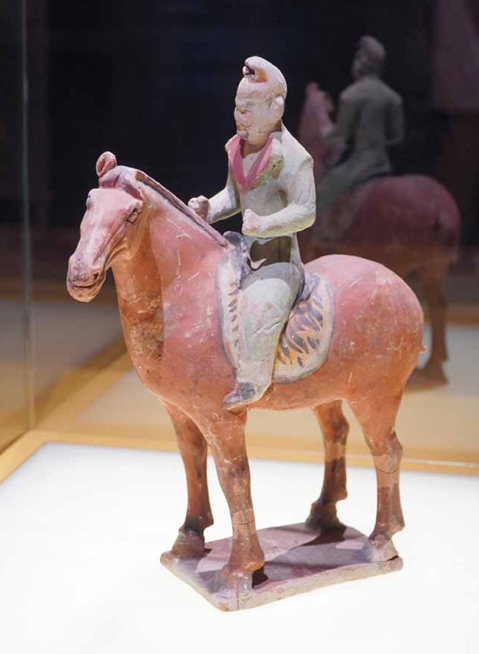
The exhibition in Leeuwarden includes magnificent examples of sancai (tricolour) pottery, particularly horse figures. These pieces were produced as tomb goods for the elite—objects intended to accompany the deceased into the afterlife. The three-coloured glaze technique, with characteristic green, amber, and cream, reached its peak during the Tang and was applied to many forms, especially horses and camels. What sets these horses apart is their liveliness: some stand proudly upright, others gallop, others turn their heads as if reacting to something. This naturalistic style reflects a shift away from the more rigid forms of earlier dynasties.
Strikingly, horses in the Tang period were not ridden only by men. Murals and ceramics depict elegant Tang women on horseback, often wearing sumptuous garments and sometimes playing polo. Polo (jiju) was a favourite sport among the elite, and women participated enthusiastically. Artistic depictions show women competing—sometimes even in mixed teams. Wu Zetian encouraged this practice, believing it strengthened women physically and mentally—a small but meaningful revolution in gender roles. Under her rule, women enjoyed a brief period of increased visibility and freedom—captured silently in the ceramic horses.
Wu Zetian as a Feminist Icon? A Nuanced Approach
Is it accurate to label Wu Zetian, a ruler from fifteen centuries ago, as a feminist icon? The question is complex. She did not rule with the aim of advancing women’s rights in any modern sense. Her goal was power and the consolidation of her legacy. Feminism as a movement for gender equality is a modern construct and cannot simply be retroactively applied without risking anachronism.
Nevertheless, her story is undeniably inspiring to many modern women. She defied and transgressed the limitations imposed on women of her era. Yet contemporary Chinese receptions of Wu Zetian are more ambivalent. As Harriet Evans (2017) notes, official historiography has often used Wu as an example of “exceptional womanhood”—the exception that proves the rule—rather than as a model for emancipation.
Modern Chinese feminism itself has a complex history, intertwined with national politics. Since the 1990s, a form of “popular feminism” has emerged among younger, urban, highly educated women. Within this movement, Wu Zetian is invoked in memes, poetry, and online campaigns as a symbol of female autonomy—especially on platforms such as Weibo and Bilibili, where she lives on as “the empress who rewrote the rules.”
At the same time, official discourse emphasises her “masculine” qualities to explain her exceptionality, while young women continue to face pressure to marry and become mothers before thirty. This contradiction reflects broader tensions in contemporary gender discourse, where ambition in education and careers is encouraged but constrained by persistent traditional norms.
Chinese feminist thinkers have rediscovered Wu Zetian as a paradigmatic example of a woman who forged her own path in a world not designed for her. As the only female emperor in Chinese history, she demonstrates that female power is not a modern invention but a historical reality—even if rare.
Male historians such as Sima Guang (1019–1086) depicted her as “unfeminine” or “monstrous”—as though a woman could not be powerful without abandoning her femininity. This misogynistic pattern appears in specific accusations, such as the claim that she strangled her own newborn daughter to frame the empress—an accusation modern scholars such as Chen Jo-shui (1994) consider fabricated. Chen notes that the trope of the child-murdering woman was used to portray powerful women as unnatural (Chen, 1994, p. 147).
Other powerful women—such as Empress Lü of the early Han and Empress Dowager Cixi of the Qing—were similarly depicted as cunning or evil. Lisa Raphals (1998) shows how such negative portrayals stem from Confucian gender norms, which confined women to the domestic sphere (nei) and regarded political action (wai) as improper. The fear that female political agency threatened cosmic order shaped historiographical depictions.
Wu’s reputation as a tyrant must be understood in this context. Executions ordered by her are described in more gruesome detail than those ordered by male emperors who were objectively more violent (Dien, 2003). Carlton (2019) notes that when male rulers eliminated rivals, this was framed as necessary for state security, whereas Wu’s similar actions were portrayed as cruel or vengeful (Carlton, 2019, pp. 83–85).
Modern interpretations challenge these biases and show that Wu strategically utilised her female identity. Tung (2001) demonstrates how Wu aligned herself with Buddhist goddesses and maternal metaphors. She presented herself as a manifestation of Bodhisattva Maitreya and adopted the title “Holy Mother” (shengmu), reworking Confucian ideals of motherhood into tools of political power (Rothschild, 2008, p. 195). Judge (2008) argues that Wu’s life illustrates both the possibilities and limitations of female agency in premodern China.
Wu Zetian and Modern Female Leaders: Historical Comparisons
Comparisons between Wu Zetian and modern female leaders must be approached cautiously. Contemporary women lead within democratic systems with formal legal equality, whereas Wu operated in a patriarchal system where female rule lacked legitimacy. Her decision to adopt the title “emperor” rather than “empress” reflects this structural gulf—she had to appropriate masculine authority to claim political power.
Modern female leaders face the “double bind” described by Mary Beard (2017): criticised for appearing “too feminine” (and therefore weak) or “too masculine” (and therefore unnatural). Though the experiences appear superficially similar, the underlying structures differ fundamentally.
What unites them is the need to develop strategies to legitimise leadership within norms historically shaped by male authority. The creativity and resilience this requires connects women across the centuries, even within vastly different frameworks.
Ceramics as Power — A Feminine Heritage
The exhibition in Leeuwarden connects us with a fascinating period in Chinese history where art and power, tradition and innovation converged. The ceramic horses with their vibrant glazes are not only aesthetically captivating but tell the story of a society in motion. Wu Zetian’s extraordinary life invites us to reflect on how we view female authority today. Her story reminds us that historical representations are often shaped by bias and that it is worth revisiting the past with fresh eyes.
For young women with ambition in traditionally “male” domains, Wu Zetian offers a powerful example of someone who achieved her goals not by conforming to expectations but by fundamentally challenging them. The combination of exquisite art and a compelling historical narrative makes the Wu Zetian exhibition a must-see. And perhaps, like me, you may leave the museum with a newfound fascination for ceramic horses and a deeper appreciation of an extraordinary woman who left her mark on world history over thirteen centuries ago. The colourful Tang horses may charm us with their elegance, but behind them lies a story of ambition, power, and emancipation that still resonates today.
Sources
Beard, M. (2017). Women & Power: A Manifesto. Profile Books.
Campbell, Denise (ed.), Peng Wen & Lv Bo. Wu Zetian: De enige vrouwelijke keizer van China. Zwolle / Leeuwarden: Waanders Uitgevers / Keramiekmuseum Princessehof, 2024. ISBN 9789462625754.
Carlton, K. (2019). “Empress Wu and the Creation of a New Female Political Identity.” Journal of Women’s History, 31(2), 77–99.
Chen, J. (1994). “Empress Wu and Proto-Feminist Sentiments in T’ang China.” In F. Koorn & M. Timmers (Eds.), Women in Chinese Patriarchy: Submission, Servitude and Escape (pp. 134–157). Hong Kong University Press.
Dien, D. S. (2003). Empress Wu Zetian in Fiction and History: Female Defiance in Confucian China. Nova Science Publishers.
Evans, H. (2017). Defining Women in Modern China. University of California Press.
Fitzgerald, C. P. (2018). The Empress Wu (4th ed.). Routledge.
Guisso, R. W. L. (1979). The reigns of the empress Wu, Chung-tsung and Jui-tsung (684–712) (Vol. 3). Cambridge University Press.
Judge, J. (2008). The Precious Raft of History: The Past, the West, and the Woman Question in China. Stanford University Press.
Mussies, Martine, & Guido van Oss. “Inspiratiebronnen voor het Chinese feminisme.” China Nu 48, no. 4 (2023): 21–26.
Raphals, L. (1998). Sharing the Light: Representations of Women and Virtue in Early China. SUNY Press.
Rothschild, N. H. (2008). Wu Zhao: China’s Only Woman Emperor. Pearson Longman.
Rothschild, N. H. (2015). Emperor Wu Zhao and Her Pantheon of Devis, Divinities, and Dynastic Mothers. Columbia University Press.
Tung, J. (2001). Fables for the Patriarchy: Gender Politics in Tang Discourse. Rowman & Littlefield.